
Learning Music Beyond the Notes: A New Approach to Burgmüller's Arabesque
Sep 28, 2026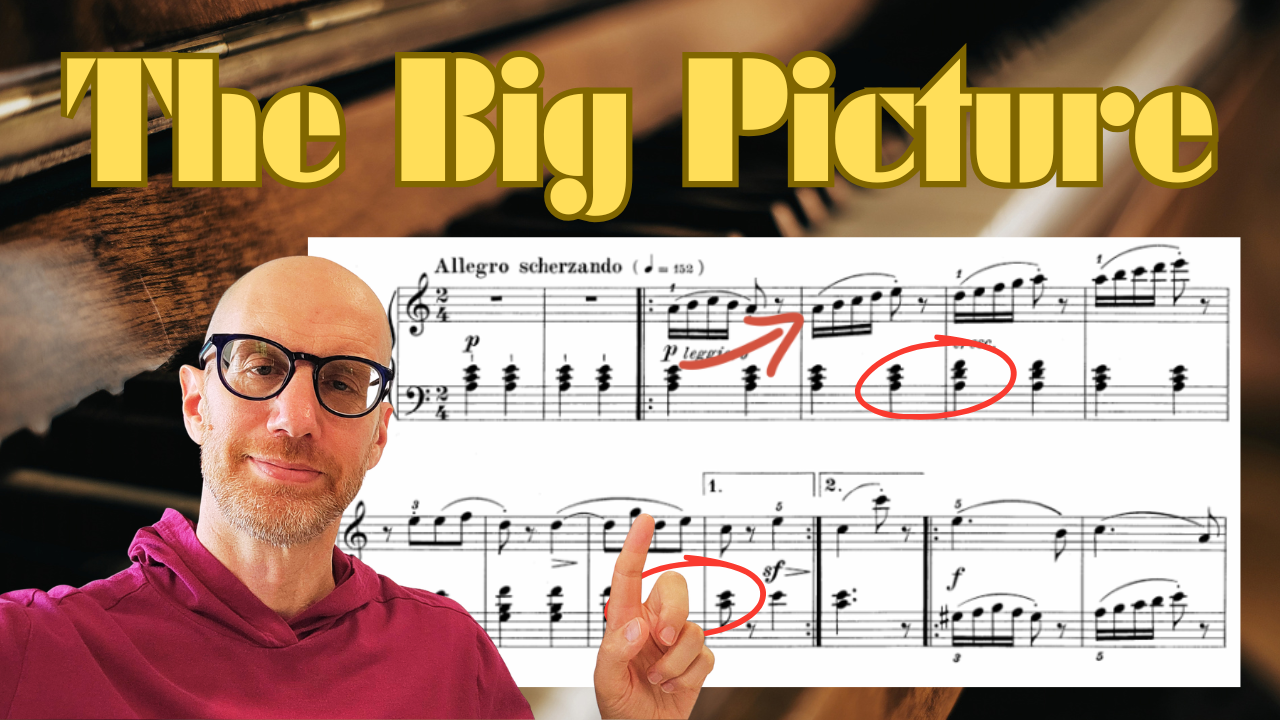
Today marks the first day of a new YouTube series I've been working on — and a new channel that will focus entirely on teaching music.
A lot of us learned — and teach — in a way where the sheet music is taken very literally from the very start of a project. I wanted to share a different approach in this series. The goal is to learn what's on the page deeply, by not taking the page so literally.
The first video highlights this approach with a piece most piano students know: Burgmüller's Arabesque (Op. 100, No. 2).
▶️ [Click Here to Watch the full breakdown on YouTube ]
Not note by note — idea by idea
We break down Arabesque — not note by note, but idea by idea:
-
The chords, and how they're built from inversions
-
The melody fragments, and how they repeat, transpose, and invert
-
The reasons we use different minor scales for different situations
-
The iv-V7-i progression with voice leading you can borrow for your own playing
-
A series of left-hand patterns you can swap in for coordination and creative work
And for each one, we turn it into a drill you can play at your piano right now.
Start with the chord inventory
Before playing a single note, we identify every chord in the piece:
-
A minor — all white keys, the home chord
-
D minor — the same shape as A minor, just inverted (A-D-F instead of D-F-A)
-
C major — also inverted (G-C-E), and only one note different from A minor
-
G7 — the first four-note chord, and the chord whose job is to resolve to C
-
E major — appears in first inversion, with a G# that signals something important
-
A sus4 — a suspension that resolves back to A minor
Playing these as a progression — A minor, D minor, C, G7, C, E, back to A minor — teaches you the harmonic skeleton of the entire piece in under five minutes.
The drill: Play the progression slowly, in root position and inversions, until the shapes are automatic.
Learn the melodic fragments (not the melody)
Arabesque isn't built from one long melody. It's built from short fragments that repeat, transpose, and invert. The main ones:
-
1-2-3-2-1 — the opening fragment, based on the first five notes of the A minor scale
-
1-2-3-4-5 — a straight scale run up and down
-
3-2-1-2-3 — the same shape in reverse
-
5-4-3-2-1-7-5 — a longer pattern that outlines the harmonic minor sound
The drill: Play each fragment up and down the scale, then in retrograde (backwards). This builds the shapes into your hands and teaches you to hear them in any key.
Understand the minor scales (and why the G# matters)
At one point, Burgmüller replaces the G natural with a G#. That single change turns the natural minor scale into the harmonic minor scale — and it accounts for the harmony of the five chord (E major, in this case).
This is why the piece suddenly sounds more dramatic. It's not decoration. It's function.
Different minor scales exist for different situations, and this piece is a perfect example of why.
The drill: Play the 1-2-3-2-1 fragment up the scale, but replace every G with G#. Then reverse the pattern. This challenges your fingerings, strengthens the weaker fingers, and teaches you to hear harmonic minor as a color, not just a scale.
Steal the iv-V7-i progression
The middle section of Arabesque uses one of the most common progressions in all of music: the iv-V7-i. In A minor, that's D minor → E7 → A minor, with beautiful voice leading in the left hand.
Burgmüller writes it so the left hand plays a melody of its own: 7-1-2-1-7, then a 1-2-3-4-5. It's a masterclass in how to move between chords without just jumping.
The drill: Play the progression in A minor, then transpose it to C minor, E-flat minor, E minor, and G minor. This is how you build the ability to navigate any progression in any key.
Practice left-hand patterns as technique
The written left hand is simple quarter notes. But you can use the same chords to build coordination and technique:
-
Alberti bass — bottom, top, middle, top
-
Repeated blocks — turn quarter notes into eighth notes, keeping them clean and light
-
Root-5th-10th — a more Romantic sound, with a pivot if you can't reach
The drill: Play through the piece with each pattern, slowly, focusing on evenness. This is where technique and musicality meet.
Why this approach works
When you learn a piece this way, you're not just learning Arabesque. You're building a vocabulary:
-
Improvisation — your hands know shapes, not just notes
-
Composition — you hear how fragments become ideas
-
Memorization — patterns stick faster than individual notes
-
Retention — you can find these shapes in any key, any piece
By the end, you won't just know Arabesque in and out. You'll have musical concepts in your system that help you learn the next piece faster, improvise, compose, and hear music differently.
The notes are the launch pad — not the final destination.
Watch the breakdown
The full video is about 30 minutes, and it works best with a keyboard nearby. If you only have a few minutes, start with the chord inventory section — that alone will change how you look at the piece.
▶️ [Click Here to Watch the full breakdown on YouTube ]
And let me know how it goes. I'd love to hear what clicks for you.
Want to go deeper?
In the Imagine Music Lab, we work through pieces exactly like this — as soloists and in ensembles. We analyze the music, build drills, and apply the concepts to pop, rock, jazz, and our own compositions. Every class is recorded, with detailed practice instructions and synopses.
It's a piano gym for adult students. Five classes a week. First month is $99.
[Join the Imagine Music Lab for Intro Rate of $99/1st Month (Usually $179)]
SUBSCRIBE FOR WEEKLY LIFE LESSONS
Lorem ipsum dolor sit amet, metus at rhoncus dapibus, habitasse vitae cubilia odio sed.
We hate SPAM. We will never sell your information, for any reason.