
How to Play Pop and Rock Piano Without Sheet Music: A Beginner's Guide
Oct 05, 2026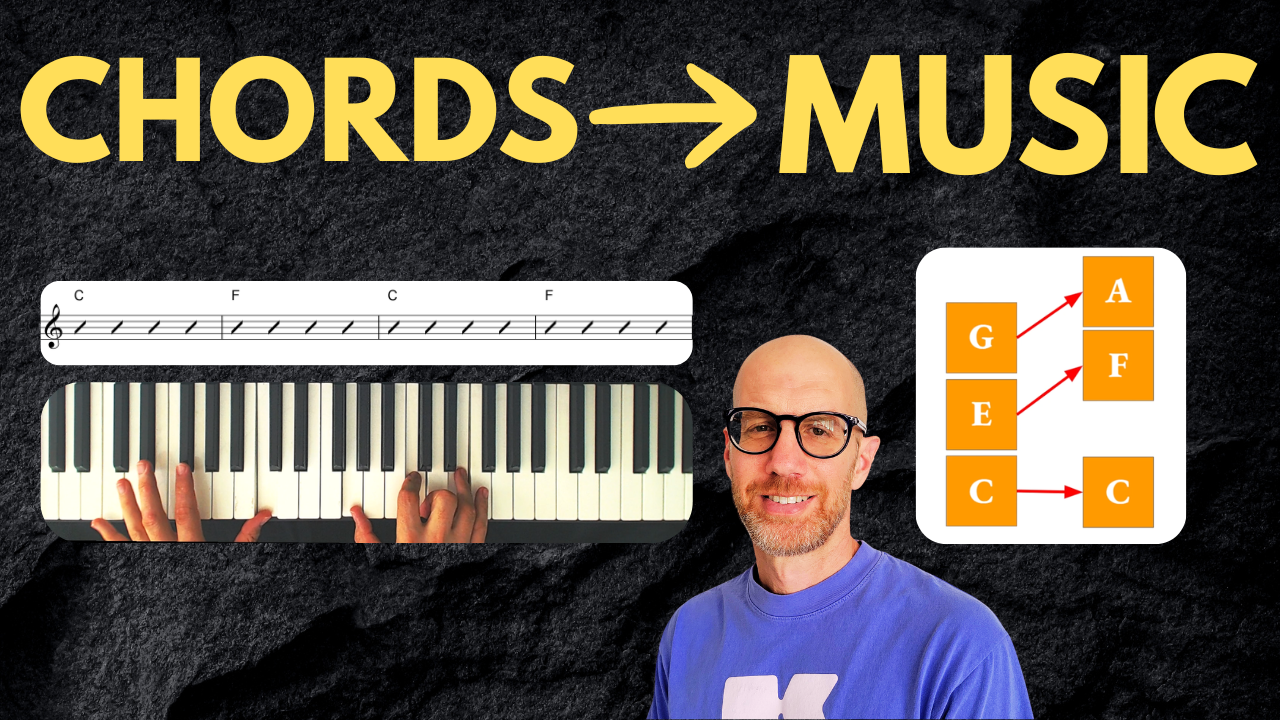
If you've ever wanted to play pop and rock songs on the piano — for your church, to accompany yourself singing, or just for fun — but you've only ever played from sheet music, this guide is for you.
In this lesson, I break down the real nuts and bolts of contemporary piano playing: the roles of each hand, the grooves that drive popular music, how to build chords from scratch, and the single most important skill for playing smoothly — resolving to the nearest inversion.
By the end, you'll have everything you need to be functional on most pop and rock songs.
Who This Is For
This lesson serves two types of players:
- Beginners who want to play for their church, accompany themselves singing pop songs, or play popular music for fun.
- Experienced pianists who have only ever played from sheet music and don't know what to do when they're handed a chord chart.
If either of those describes you, you're in the right place.
The Roles of Each Hand
The first thing to understand is that pop and rock piano is built on a division of labor between your hands.
The Right Hand: Timekeeper and Harmony
The right hand is the timekeeper. In a chord chart, the slashes represent each beat in a measure. Four slashes before a vertical line means four counts of that chord. Your job is to keep that steady, even if you're not playing a specific pattern.
The right hand's primary role is to provide harmony — not melody. This is a common mistake. When a singer is singing the melody, you don't want to be playing it too. It gets in their way and can reveal when they're out of tune.
The right hand does have other jobs:
- Fills and embellishments between vocal phrases
- Strategically harmonizing the melody when you know it well
- Taking solos or playing interludes
- Marking different sections (verse vs. chorus vs. bridge) to add variety
The Left Hand: Roots and Power
The left hand provides the roots — the bottom note of each chord. It plays simple rhythms that give the music low-end power. The left hand can also propel you into the next section or chord with syncopation or a lead-in.
Putting Your Hands Together: The Basic Groove
Start simple. In your right hand, play a C major chord (C–E–G). In your left hand, play octaves on C.
Play four counts in the right hand, then restrike the left hand every four beats. That's your foundation.
From there, you can add:
Syncopation in the Left Hand
Syncopation means playing between the beats. Start by playing on the "and" of beat two and the "and" of beat four. This mimics what a bass player would do and adds momentum.
The Wobble in the Right Hand
Double up the rhythm in your right hand with a little wobble — you've heard this pattern a zillion times in popular music. It adds energy and works especially well in choruses.
Right-Hand Arpeggios
Instead of playing all the chord notes together, break them up and play them one at a time. This creates a flowing, eighth-note texture.
Groove vs. Tricks: When to Play What
A key skill is knowing when to play simple and when to get busy. Generally, you want more activity when the singer is less active, or in sections that need more energy. Practice switching between the basic beat, the wobble, and arpeggios mid-song.
How to Build Any Major or Minor Chord
If you're new to chords, you don't need to memorize them all. You just need two formulas.
Major Chords: 4 + 3 Half Steps
Start on any note. Go up four half steps, then three more half steps. That's a major chord.
Example: C → (4 half steps) → E → (3 half steps) → G = C major.
Minor Chords: 3 + 4 Half Steps
Reverse the formula. Start on any note. Go up three half steps, then four more.
Example: C → (3 half steps) → E♭ → (4 half steps) → G = C minor.
Use your ear as the final judge. If it doesn't sound major or minor, you miscounted — adjust the middle note.
Inversions: The Key to Smooth Playing
Think of a chord as three wooden blocks stacked up, each with a note name on it. For C major, the blocks say C, E, G.
- Root position:** C on the bottom (C–E–G)
- First inversion:** Move C to the top (E–G–C)
- Second inversion:** Move E to the top (G–C–E)
All three are still C major chords — just different arrangements of the same notes.
How to Find the Root of Any Inversion
Look for the largest gap between any two adjacent notes. The root of the chord is always the note on top of that gap.
This works for every inversion of every chord.
The Most Important Skill: Resolving to the Nearest Inversion
This is the real power of inversions. Instead of jumping all over the keyboard when you change chords, you move as little as possible.
Here's how it works with C to F:
- Play C major in root position (C–E–G).
- Keep your thumb on C.
- Slide the other two fingers up a step to F and A.
- You're now playing F major in second inversion (C–F–A).
The common tone (C) stays put. The other notes move the smallest distance possible. That's called voice leading, and it's essential for playing contemporary music at a high level.
You can do this from any inversion of C to the nearest inversion of F. The principle is always the same: keep common tones, move everything else the shortest distance.
Why This Matters
In most music, the melody and bass jump around. The middle notes — the ones your right hand plays — should stay relatively still. Smooth resolutions make your playing sound professional instead of choppy.
Applying It to Real Songs
Once you have inversions and resolutions down, you can apply them to real progressions.
"Let It Be" by The Beatles
The progression is C–G–Am–F, with each chord lasting two beats. Practice switching inversions on each beat while still resolving to the nearest inversion of the next chord.
A Common D Minor Progression
Dm–B♭–F–C is a staple of songs in D minor. Try it with the basic groove, then with inversions changing every measure.
"Grenade" by Bruno Mars
The intro uses Dm–Am, with each chord lasting two measures. This is a great one for arpeggios.
A Major Progression
Using your major and minor formulas, figure out the chords in A major and practice resolving smoothly between them.
What to Practice Next
If you're a beginner, this will take time. Start by playing through songs you know and love — motivation makes the learning go faster. Focus on inversions and smooth resolutions first, then add the left-hand syncopation, wobble, and arpeggios.
- If you're more experienced, stay tuned. Future lessons will cover:
- Adding swag and style to your playing
- Seventh chords and sus chords
- Walk-ups and walk-downs
- Fills around vocals and into new sections
- Improvising and taking solos
- Playing and singing at the same time
Join the Imagine Music Lab
If you liked this style of teaching, consider joining us in the Imagine Music Lab — a piano gym for adults. We meet five times a week for live classes covering classical, pop/rock, jazz, ensembles, songwriting, and production. Every session is recorded and posted in the forum, with assignments between sessions.
Special Offer Click Here: First month is $99 through the link below, then $179/month.
**Topics:** pop piano, rock piano, piano chords, chord inversions, voice leading, piano for beginners, play piano without sheet music, chord charts, contemporary piano